
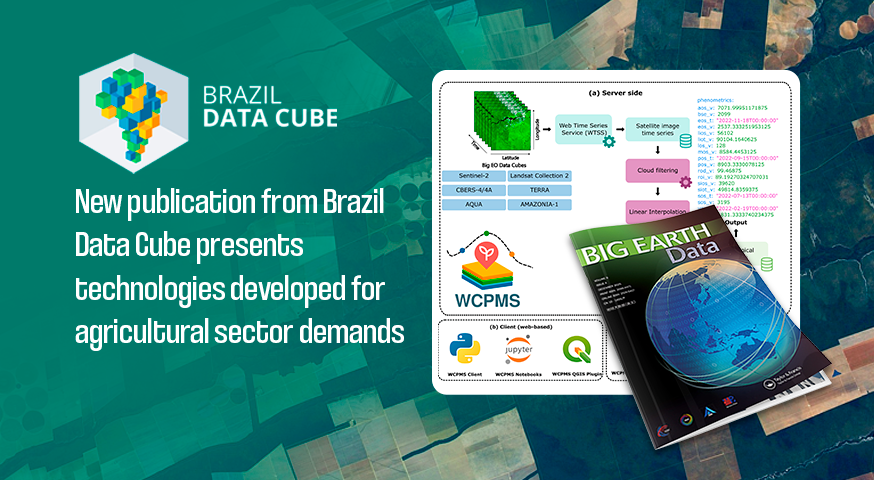
New publication from Brazil Data Cube presents technologies developed for agricultural sector demands
The article “A tool for crop phenology metrics analysis from big Earth observation data” was published this week in the journal “Big Earth Data” by the Brazil Data Cube project team, which presents technologies developed to meet the demands of the agricultural sector. It is the result of research conducted by PhD candidate Gabriel Sansigolo and researchers Dr. Karine Reis Ferreira, Dr. Gilberto Ribeiro de Queiroz, Dr. Marcos Adami, and Dr. Thales Sehn Körting, all from the National Institute for Space Research (INPE), as well as Leonardo Pereira Garcia Leão from the Federal Court of Accounts (TCU).
The article demonstrates advances in the research and development of a free and open-source tool for phenological metrics analysis from large EO image collections that runs on server-side infrastructure and does not require local data downloads. The Web Crop Phenology Metrics Service (WCPMS) is the core of this tool, designed to estimate phenological metrics as a web service. The tool extracts phenological metrics associated with spatial locations, based on the Brazil Data Cube (BDC) platform. It calculates phenological metrics from data cubes of distinct remote sensing image collections. The potential of the tool is shown through an experiment estimating soybean sowing dates using phenological metrics compared with field data obtained in the Central-South region of Brazil.
The proposed architecture and the system developed in this work represent the first stage of new technologies that BDC is developing to meet the demands of the agricultural sector. The article can be accessed at: ”https://doi.org/10.1080/20964471.2026.2641272”.
This article is an extended version of “Paper on Brazil Data Cube tool wins award at XXI Brazilian Symposium on Remote Sensing“.