 BIG Catalogue
PNG
Type of resources
Available actions
Topics
Provided by
Formats
Representation types
Update frequencies
status
-

Esta coleção reúne imagens ópticas adquiridas pelos sensores WFI (Wide Field Imager), embarcados nos satélites do INPE: CBERS-4, CBERS-4A e AMAZONIA-1. As imagens referem-se às regiões de Franca (SP), Franca Nordeste (SPNE) e partes da Amazônia brasileira, com destaque para o monitoramento de áreas naturais, queimadas, cobertura de nuvens e corpos hídricos. Os arquivos seguem um padrão de nomenclatura que codifica informações como a localidade (ex.: Franca_AMAZONIA, Franca_SP), o sensor utilizado, a data da imagem (AAAAMMDD), órbita / ponto, o nível de processamento (ex.: L4), composições espectrais (ex.: BAND4321, BAND16151413) e tipo de processamento (ex.: RegAWFI). Os dados estão disponíveis nos formatos .tif e .png.
-
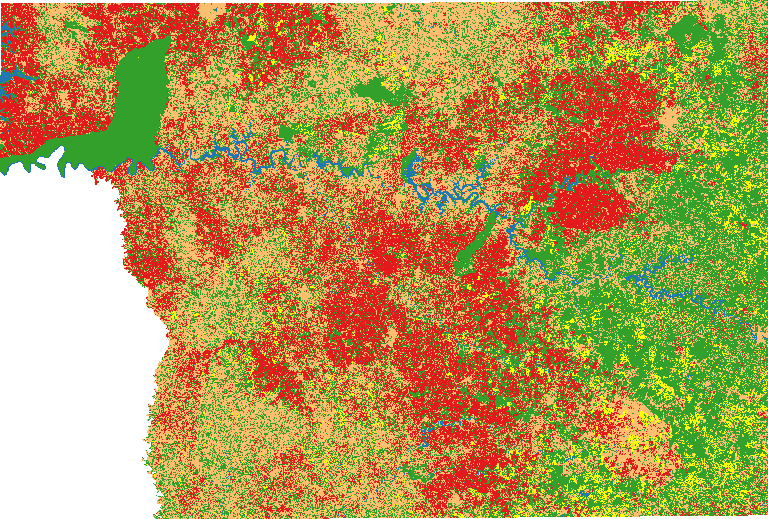
This is a land cover classification map of Brazilian Amazon, from January to December of 2018. This classification was made on top of Landsat-8 biweekly cubes with spatial resolution of 30 meters, using the best pixel composition function named as Least Cloud Cover First (LCF), which was previously named Stack in BDC older versions. The input datacube was Landsat-8 - OLI - Cube Stack 16 days - v001, which was deprecated. The classification model was trained using 2303 sample points (Agriculture: 405, Forest: 1284, Pasture: 482). The spectral band used were B1, B2, B3, B4, B5, B6, and B7 along with the vegetation indices EVI and NDVI; the clouded observation were identified using the Fmask4 algorithm and estimated using linear interpolation. The classification algorithm was Random Forest. The post-processing included masking water (using Pekel et al 2016). This product was funded by the Brazilian Development Bank (BNDES).
-

This is a land cover classification map of Brazilian Pantanal, from January to December of 2018. This classification was made on top of Landsat-8 days data cubes with spatial resolution of 30 meters, using the best pixel composition function named as Least Cloud Cover First (LCF), which was previously named Stack in BDC older versions. The input datacube was Landsat-8 (OLI) Cube Identity - v001, which was deprecated. The classification model was trained using 6601 sample points (Agriculture: 695, Forest: 1586, Pasture: 2930, Savanna and grassland: 1181, Wetland: 209). The spectral band used were B1, B2, B3, B4, B5, B6, B7 along with the vegetation indices EVI and NDVI; the clouded observation were identified using the Fmask4 algorithm and estimated using linear interpolation. The classification algorithm was Random Forest. The post-processing included masking the label Water (Using Pekel et al 2016) and improving the labels Savanna and grassland and Pasture (using PRODES data). This product was funded by the Brazilian Development Bank (BNDES).
-

CBERS4/WFI - Level-2 Digital Number product. Level 2 products have radiometric correction and geometric correction using satellite ephemeris and attitude data (system correction).
-
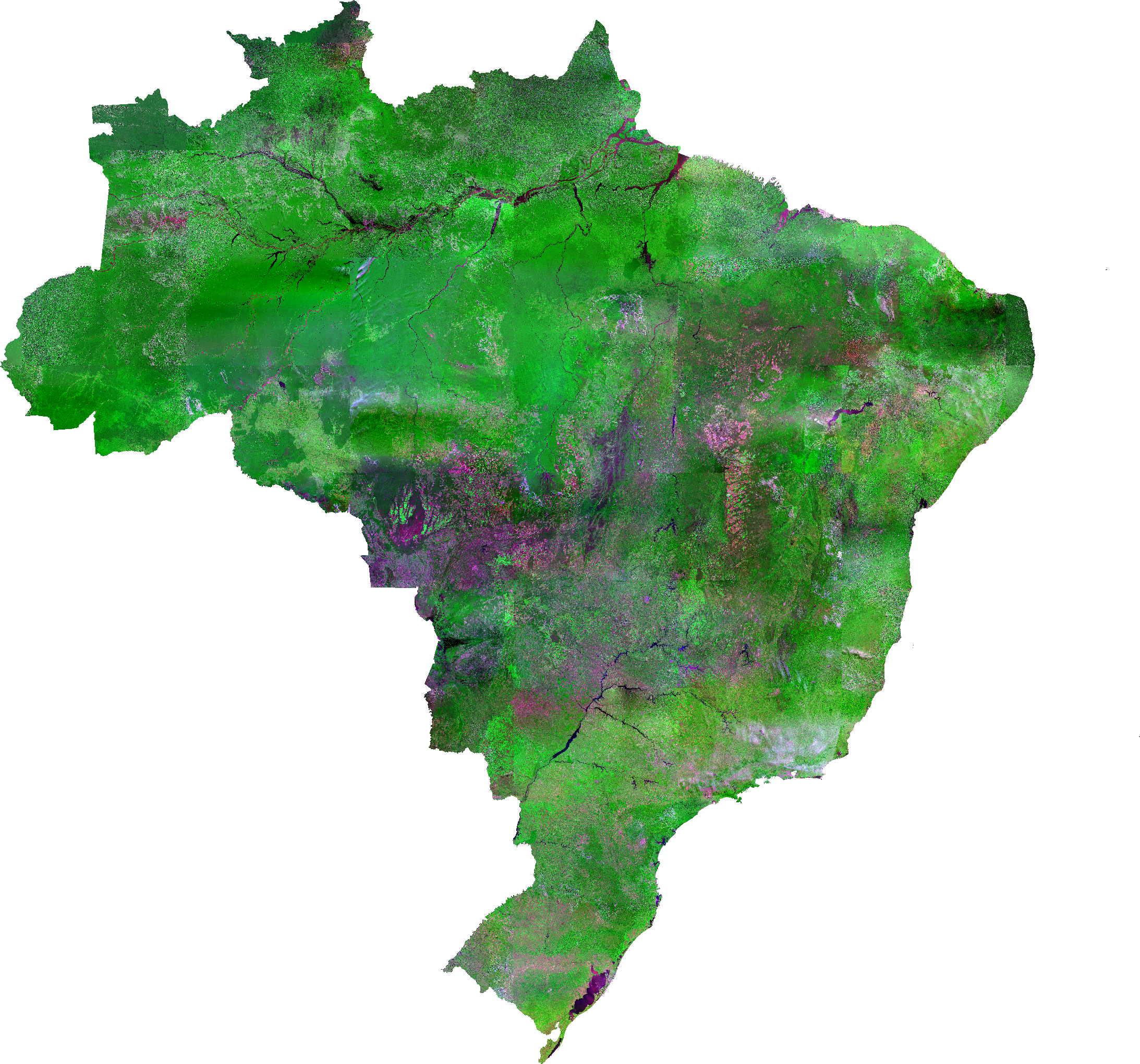
CBERS-4/WFI image mosaic of Brazil with 64m of spatial resolution. The mosaic was prepared in order to demonstrate the technological capabilities of the Brazil Data Cube project tools. The false color composition is based on the WFI bands 15, 16 and 13 assigned to RGB channels. The temporal composition encompasses 03-months of images, starting in April 2020 and ending in June 2020, with a best pixel selection approach called Least Cloud Cover First (LCF). More information on LCF can be found at Brazil Data Cube web site (https://brazil-data-cube.github.io/specifications/processing-flow.html#temporal-compositing). This Image Mosaic used more than 1200 CBERS-4 scenes and was generated based on an existing CBERS-4/WFI image collection.
-

Sentinel-2 image mosaic of Brazilian Amazon biome with 10m of spatial resolution. The mosaic was prepared in support of TerraClass project. The false color composition is based on the MSI bands 08, 04 and 03 assigned to RGB channels. The temporal composition encompasses 03-months of images, starting in june 2024 and ending in August 2024, with a best pixel selection approach called Least Cloud Cover First (LCF). More information on LCF can be found at Brazil Data Cube web site (https://brazil-data-cube.github.io/specifications/processing-flow.html#temporal-compositing). This Image Mosaic used more than 15000 Sentinel-2 scenes and was generated based on an existing data cube of Sentinel-2 images.
-

Sentinel-2 image mosaic of Brazil with 10m of spatial resolution. More information on LCF can be found at Brazil Data Cube web site (https://brazil-data-cube.github.io/specifications/processing-flow.html#temporal-compositing).
-
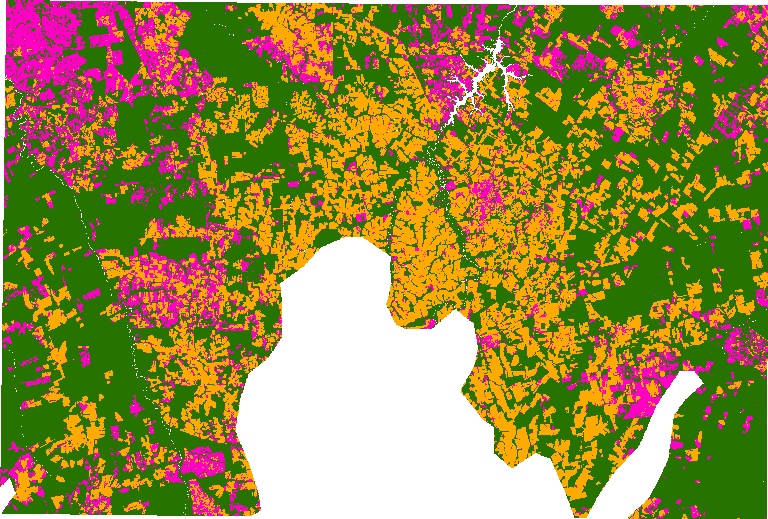
This is a land cover classification map of Brazilian Mata Atlantica, from January to December of 2017. This classification was made on top of Landsat-8 days data cubes with spatial resolution of 30 meters, using the best pixel composition function named as Least Cloud Cover First (LCF), which was previously named Stack in BDC older versions. The input datacube was Landsat-8 - OLI - Cube Stack 16 days - v001, which was deprecated. The classification model was trained using 13442 sample points of the classes Agriculture 2668, Planted forest 823, Forest (Formação florestal) 3754, Pasture 6197. The spectral bands used were B1, B2, B3, B4, B5, B6, B7, along with the vegetation indices EVI and NDVI; the clouded observation were identified using the Fmask algorithm and estimated using linear interpolation. The classification algorithm was Random Forest. The post-processing consisted on cropping the images to the biome's boundary. This product was funded by the Brazilian Development Bank (BNDES).
-

Sentinel-2 image mosaic of Brazil with 10m of spatial resolution. It uses True color composition based on the MSI bands 04, 03 and 02 assigned to RGB channels. It's input is the 16 days Least Cloud Cover First (LCF) datacube. More information on LCF can be found at Brazil Data Cube web site (https://brazil-data-cube.github.io/specifications/processing-flow.html#temporal-compositing).
-

The Aqua Moderate Resolution Imaging Spectroradiometer (MODIS) Vegetation Indices (MYD13Q1) Version 6.1 data are generated every 16 days at 250 meter (m) spatial resolution as a Level 3 product. The MYD13Q1 product provides two primary vegetation layers. The first is the Normalized Difference Vegetation Index (NDVI) which is referred to as the continuity index to the existing National Oceanic and Atmospheric Administration-Advanced Very High Resolution Radiometer (NOAA-AVHRR) derived NDVI. The second vegetation layer is the Enhanced Vegetation Index (EVI), which has improved sensitivity over high biomass regions. The algorithm chooses the best available pixel value from all the acquisitions from the 16 day period. The criteria used is low clouds, low view angle, and the highest NDVI/EVI value.